Facebook Ads for High-End Real Estate Buyers: How to Target Luxury Leads Without Burning Your Budget
By Will Rapuano | Velocity Builders|
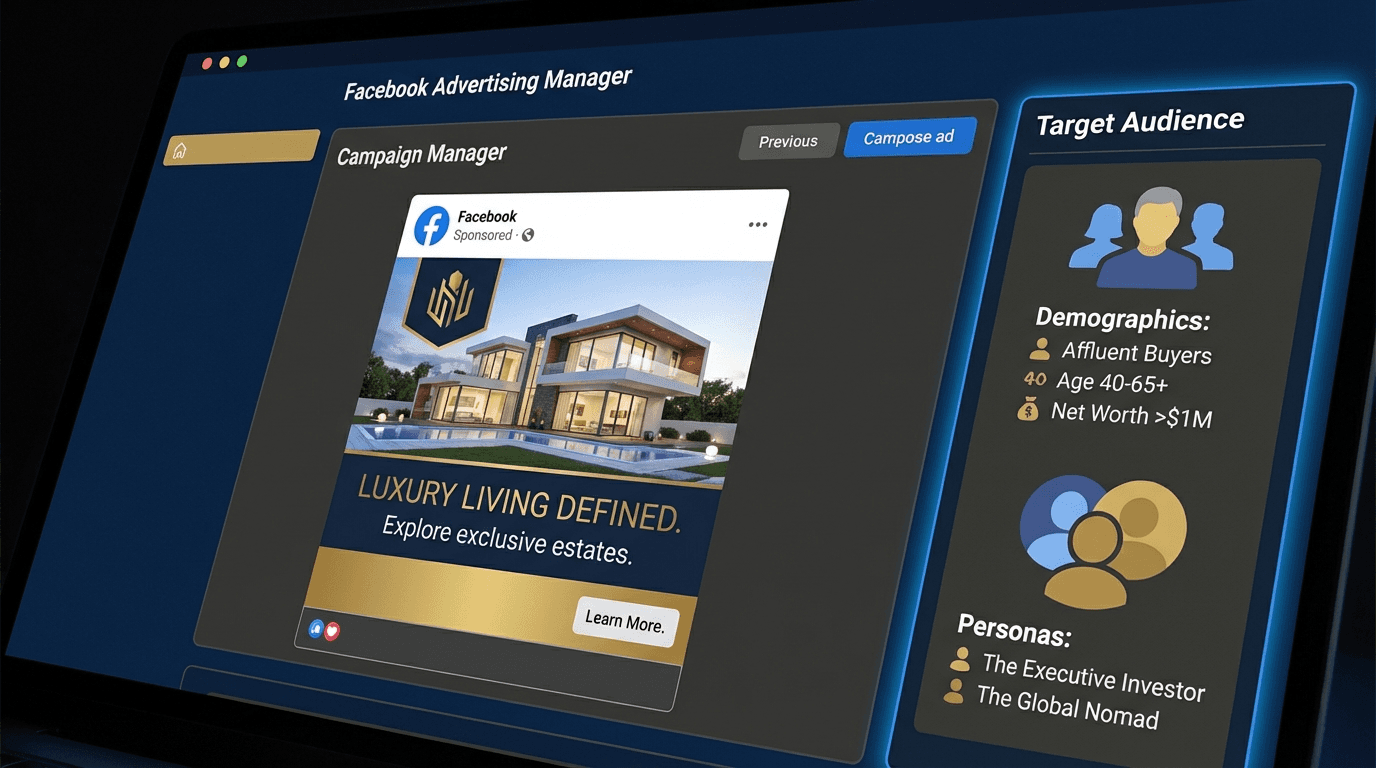
Most real estate agents treating Facebook like a billboard are bleeding budget. They run a listing post, boost it for $50, and wonder why their leads are people who can't qualify for the property they're advertising. Targeting high-end buyers on Facebook is a different discipline entirely — and when you do it right, it produces leads that are actually ready to purchase a $1.2M home.
This is the approach that works.
Why Facebook Still Wins for Luxury Real Estate
Before the strategy, the context: luxury buyers are on Facebook. Not exclusively — they're also on Instagram, LinkedIn, and Google — but Facebook's targeting infrastructure is unmatched for reaching specific income brackets and behavioral profiles in specific geographic areas.
The problem isn't the platform. It's how agents use it.
Boosting a listing to "people near [city] interested in real estate" is like sending a mailer to every address in a zip code and hoping the right person opens it. Smart targeting does the opposite: it builds a narrow profile of the buyer most likely to be looking for a $900K+ home in your market and puts your message in front of only those people.
Facebook's Custom Audiences, Lookalike Audiences, and detailed behavioral targeting give you the tools to do exactly that. You just have to use them correctly.
Step 1: Define Your Actual Target Buyer
Before you touch Ads Manager, get specific about who you're targeting. For high-end buyers, that typically means:
Household income. Facebook allows income-tier targeting. For luxury markets, you're looking at the top 10-25% income bracket in your area, depending on local market dynamics. Know the household income threshold that correlates with your price range. In Northern Virginia, for example, a $1.5M buyer typically has $400K+ household income. Know your number.
Life stage signals. Luxury buyers often have specific triggers: a recent liquidity event (stock compensation, business sale), relocation for a senior position, or a growing family upgrading from a first home. These aren't things Facebook tells you directly, but they show up in behavioral patterns — people who've recently searched for luxury home services, engaged with high-end lifestyle content, or shown interest in relocation.
Geographic precision. Luxury buyers are often relocating from specific feeder markets. In DC, that's people moving from Manhattan, San Francisco, Chicago, and Boston for government or private sector roles. You can layer in geography targeting that reaches people in those cities who have expressed interest in DC-area neighborhoods.
Job title and industry. LinkedIn does this better, but Facebook has some employer and job title targeting — particularly for tech, finance, law, and federal contracting. Pair it with the income signals and you're narrowing to exactly who you want.
Step 2: Build the Right Audience Stack
Here's the targeting architecture that consistently outperforms broad real estate audiences.
Core Custom Audience (retargeting):
Start here. Upload your existing contacts — past clients, open house attendees, email list. Run ads exclusively to these people first. They already know you. Conversion costs are a fraction of cold traffic. If you have 500+ contacts in your CRM, this is your lowest-hanging fruit.
Website Visitors (Pixel required):
Install the Facebook Pixel on your site. Any agent website worth its SEO should have this running. Build an audience of people who visited your neighborhood pages, specific listing pages, or your contact form in the last 60-180 days. These are warm leads who showed intent and didn't convert.
Video Viewers:
If you're running video content (walkthroughs, neighborhood spotlights, market updates), build audiences from people who watched at least 50% of a video. This audience has demonstrated engagement and is significantly more likely to respond to a direct-response ad than cold traffic.
Lookalike Audiences (the multiplier):
Once you have 100+ people in a custom audience, Facebook can find similar profiles across its entire user base. Build a 1% Lookalike from your best clients — people who bought in your price range. This is the cold traffic strategy that actually works for luxury: you're letting Facebook's algorithm identify the patterns from your real buyers and find more of them.
The mistake agents make here is building Lookalikes from their general email list. Be specific. Your Lookalike source should be your closed luxury buyers, not everyone who's ever contacted you.
Step 3: Creative That Connects With High-End Buyers
Luxury buyers have highly tuned BS detectors. They've seen ten agents run the same stock photo of a beige living room with "JUST LISTED" in Comic Sans. Your creative needs to do something different.
What works:
Video walkthroughs with narration. Not a silent slideshow — a genuine walkthrough where you explain what makes the property exceptional. Ninety seconds. No background music that sounds like an elevator. Talk like you're showing the home to a qualified buyer, because you are.
Neighborhood context, not just the house. Luxury buyers are buying a lifestyle, not square footage. Show what's at the end of the street — the trail system, the waterfront, the farmer's market. The house matters; the life it enables matters more.
Clean, minimal design. High-end brands don't scream. Neither should your ads. White space, quality photography, a single clear message. If your ad looks like a coupon, your audience will associate you with bargains.
Social proof with specificity. "Sold 47 homes in [neighborhood] since 2019" outperforms "Experienced Local Agent" every time. Be specific. Specificity signals credibility.
What to avoid:
Generic luxury imagery. Chandeliers and infinity pools from Shutterstock don't represent your actual listings. Use real photos from real homes you've sold or represented.
Multiple CTAs. Pick one. "Schedule a private showing" or "Download the neighborhood guide" — not both. Confusion kills conversions.
Price in the ad copy. This is a judgment call, but leading with price often attracts unqualified clicks. Lead with the experience and lifestyle, then qualify through your landing page.
Step 4: The Landing Page Is Where Campaigns Die
Most agents send Facebook ad traffic to their homepage or a generic IDX search. This is where money evaporates.
Your landing page needs to:
Match the ad exactly. If your ad promotes a Lake Barcroft lifestyle guide, the landing page delivers the Lake Barcroft lifestyle guide. Every step of mismatch bleeds conversion rate.
Capture the lead immediately. A form above the fold. Name, email, phone — that's it. Every additional field kills your conversion rate. You can qualify later.
Prove your authority fast. One testimonial from a luxury client, your transaction count in the specific price range, a professional headshot. This all needs to be visible without scrolling.
Load fast. Luxury buyers aren't waiting six seconds for your hero image to render. Page speed matters for conversion just as much as design.
Step 5: Budget Allocation That Actually Makes Sense
Luxury real estate Facebook ads require more patience and more budget than typical campaigns. Here's how to think about it:
Retargeting (your warm audiences): 40% of budget. This is your best ROI. Small audiences, high intent. You can run these at $10-15/day.
Lookalike audiences: 40% of budget. This is your growth engine. Expect higher cost-per-lead, but the leads are qualified if your source audience is good.
Cold broad targeting: 20% or less. Use this only for brand awareness and video view campaigns to feed your warm audiences. Do not expect leads directly from cold traffic.
Minimum viable monthly budget for luxury markets: $800-1,500/month. Below this, you won't generate enough data for Facebook's algorithm to optimize. Agents who spend $200/month and say "Facebook doesn't work" are running campaigns Facebook can't learn from.
Step 6: Track What Actually Matters
Facebook will show you metrics that feel good but mean nothing. Vanity metrics to ignore: reach, impressions, page likes, post reactions.
Metrics that matter:
Cost per lead. How much are you paying per form submission? For luxury real estate, $25-75/lead is reasonable depending on your market and ad quality.
Lead-to-appointment rate. Are your leads converting to actual consultations? If you're getting 30 leads and zero appointments, the targeting may be right but your follow-up sequence is broken.
Cost per closed transaction. This is the real number. Work backward from your commission to determine your acceptable cost per acquisition.
Facebook Ads Manager has a conversion tracking function. Use it. Without tracking real outcomes, you're flying blind.
Common Mistakes Luxury Agents Make
Running interests-only targeting with no behavioral layer. "Interested in luxury real estate" as your only targeting criterion means you're reaching people who like the idea of luxury homes, not people with the financial profile to buy one.
Turning off ads too early. Facebook needs 50 conversion events to exit the learning phase. If you're pausing campaigns after 7 days because the cost-per-lead looks high, you're sabotaging the algorithm before it can optimize.
Using the same creative for 60+ days. Ad fatigue is real, especially in small audiences. Rotate creative every 4-6 weeks.
Skipping retargeting entirely. This is the most common and most expensive mistake. Your warm audience is where luxury leads convert. If you're only running cold traffic, you're ignoring your best opportunity.
Frequently Asked Questions
Velocity Builders helps real estate agents, lenders, and brokerages build websites and marketing systems that generate and convert leads automatically.
Will Rapuano
Founder, Velocity Builders LLC. Business Development Officer at Pruitt Title. Helping real estate agents and loan officers scale with better marketing systems.
Book a 20-Minute Growth Blueprint
See where your lead handoff and follow-up are leaking deals, then fix the right things first.
Book a 20-Minute Growth Blueprint